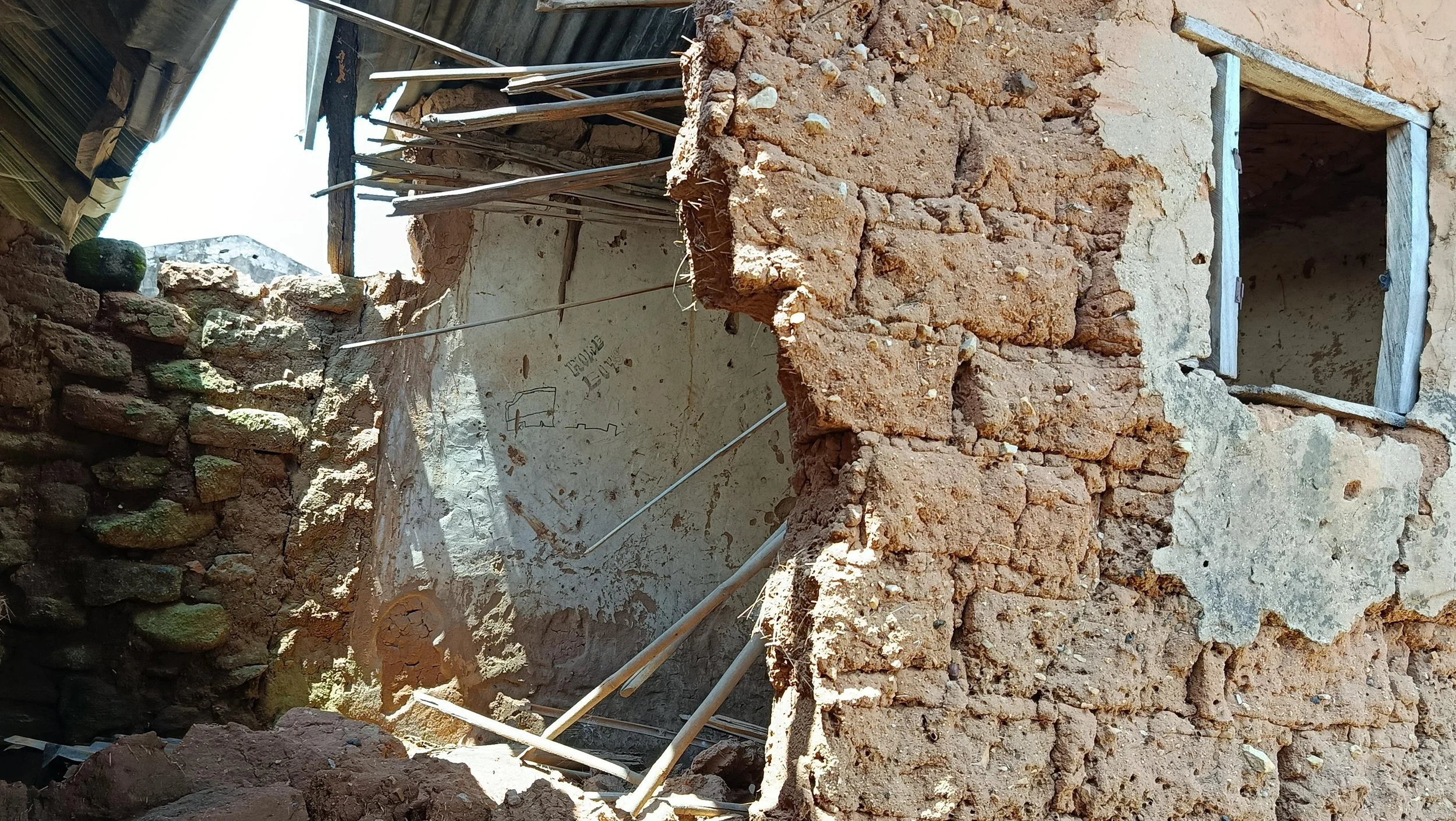
Photo source: Yakubu Samaila
The order of the world exists in the tension of passion. On one hand, we, as modern humans, experience the joy of freedom, the luxuries of choice, and the pleasures of a world that is far more accessible today than previous centuries had experienced. But then lies another kind of passion: that of greed and degradation, manipulation and control, all of which encompass the desire or lust for power.
We’d like to believe that we have evolved, that even despite the borders that reduce our ability to connect, we’ve adopted a perspective that idolises the militant law of border control as a form of protection from an unknown danger.
Centring the African perspective and Françafrique’s influence, we begin to see how a frame of exclusion has been built around us. As we search for ourselves within the ideal of a democratic world and wrap ourselves in the language and passion of freedom, its scent, inviting at first, slowly reveals a darker truth. It exposes how far we have drifted from the agency of liberation, accepting the concealed reality that the borders drawn across African land by the West were never meant to unite us but to divide us.
The strike of dominance: Africa’s pushback against the rising tide of neocolonial imperialism
While others enjoy the liberties secured by treaties written in distant pasts, granting them free rein over our wealth, we are left navigating a pseudo-democratic reality that never truly delivers. One that has stripped us of leaders who genuinely care for the societies they are meant to serve and distanced us from the collective power needed to reclaim our own future.
In a book by Achile Mbembe titled Necropolitics, he writes, “…war is determined as an end and necessity not only in democracy but also in politics and culture.” For a book originally published in 2011, how poetic does it ring true today?
On 25 December 2025, while much of the world marked the festive holiday, the United States launched air strikes on a small community in northwestern Nigeria, framed as a defence against religion and antiterrorism. The strike came amid a major geopolitical shift in the Sahel region, following Niger, Burkina Faso, and Mali’s withdrawal from the Economic Community of West African States (ECOWAS) to form their own confederation, the Alliance des États du Sahel (AES).
The Sahel States’ expulsion of Western multinational corporations to control over their natural resources and exit from ECOWAS it has signalled a clear break from Western dominance. Speaking at the Confederation of Sahel States summit in Bamako on 23 December 2025, just 48 hours before the U.S. strike, Ibrahim Traoré, President of the Transition of Burkina Faso, warned that a “black winter” was approaching, stating:
« Il y a quelque chose qui vient sur l’Afrique de l’Ouest. Je l’ai appelé l’hiver noir.
L’hiver noir arrive. Ce sera un hiver très froid, un hiver sanglant, un hiver meurtrier. En fondant la Confédération de l’AES, nous avons senti ce froid venir. Et chaque jour que Dieu fait, nous nous évertuons à trouver des troncs d’arbres pour allumer un feu : un feu qui va réchauffer le cœur des Africains, un feu qui va réchauffer les mentalités et le sang des Africains, afin de nous unir. »En: “There is something coming over West Africa. I have called it the black winter.
The black winter is coming. It will be a very cold winter, a bloody winter, a deadly winter. In founding the AES Confederation, we felt this cold approaching. And every day that God gives us, we strive to find tree trunks to light a fire: a fire that will warm the hearts of Africans, a fire that will warm the minds and the blood of Africans, so that we may unite.”
Now, moving beyond Western media propaganda, the attack on Nigeria reflects a post-colonial war of conquest and occupation. Niger, Mali, and Burkina Faso lie just north of Nigeria. These three nations have revoked mining licenses from French multinational corporations, nationalising control over uranium, gold, and other resources to gain economic sovereignty from former colonial powers, while Chad, Côte d’Ivoire, and Senegal have joined in ending French defence agreements. The Western government is clearly desperate.
As Françafrique’s grip weakens, the fractures within African solidarity come to light
Since resistance to Françafrique began in 2022, France’s global power has been at stake. Through the CFA franc system, France has maintained colonial influence over 14 African states, requiring them to deposit half their foreign exchange reserves in the French Treasury. Against this backdrop, Trump’s attack on Nigeria appears as a fog masking its true intent. It has never been about defending religion, but about access to African wealth. If the survival of this ancient imperialist order is at stake, is it any surprise that Nigeria has been targeted?
Mbembe writes: “…colonial violence worked to capture the force of desire of the subjugated and channel it into unproductive investments. By claiming to be acting on behalf of the interests of the natives and thus in their stead, the colonial machinery sought not merely to block their desire to live. It aimed to affect and diminish their capacities to consider themselves moral agents.”
The sad reality of our African brotherhood is that we have become so brainwashed that a new wave of war has begun. Besides the violence of nuclear machinery and the capitalist market that drives greed and power, there’s a war that pits species, humans, against one another. In this wave of Africa’s revolution, Nigeria, the seat of ECOWAS and the economic bloc long used to keep West African states under the shadow of the African Union, itself tied to the European Union, stands at a breaking point. Add to that the rift with the AES, and we see how fragile the position of those who profit from a system that has spent decades breaking, exploiting, and stripping Africans of their sovereignty and essence really is.
Ben Okri’s The Freedom Artist explores a consciousness of humankind that is chained in the mind, under the illusion of freedom, blind to the fact that we are prisoners of the world we inhabit. It asks: What does freedom truly mean, and does it even exist?
For example, if we see democratic rule as freedom, the civil agency to participate, to set standards for how leaders govern, we overlook a critical truth: we are always operating within some form of governance. It is a system that may appear less oppressive yet still imposes control. In acts of war or violence, two realities emerge: one group believes in its perceived justice, while the other bears its consequences, claiming its innocence.
To whom does equality belong, and how do we clarify the distinction?
The Sahel States’ call to unite towards Africa’s liberation
In much of Africa, we have inherited a civilisation shaped by colonial order. Advocating for leaders is not simply a choice; it is participation in a system of power that demands alignment and discipline. Yet the path to a just and equal society begins with transforming the collective body. The Black body must see itself beyond the prejudice of race and understand itself as a living being, not as “the other,” bound to a history of territorial dominance.
When we move toward reciprocity and care for our African humanity, the questions President Ibrahim Traoré asks: “Why is the black man like this? Why can’t we see the danger coming, unite, and protect ourselves?” find their answer in Achille Mbembe, who urges that the colonized must turn their back on Europe, standing tall beyond the categories that once forced us to bow and scrape.
As Africans, true liberation begins when we lean on the force of the collective, starting with how we perceive leadership and define the continent we want to shape. We may never fully erase the fragments of colonialism that still bind us, but we must act in allegiance to the African flame of unity, without borders.
Until we move beyond the pretence of democracy and hold our leaders accountable against the imperialist structures imposed upon us, we remain constrained. As President Traoré urges, we must endure, and when the symbolic Black Winter arrives, we should act in allegiance to the hope of those who fought for our liberation. No manipulation should divide us, and no one should harbor hatred toward another. A language we hope will one day reach our leaders, in fidelity to our Pan-Africanist heritage.