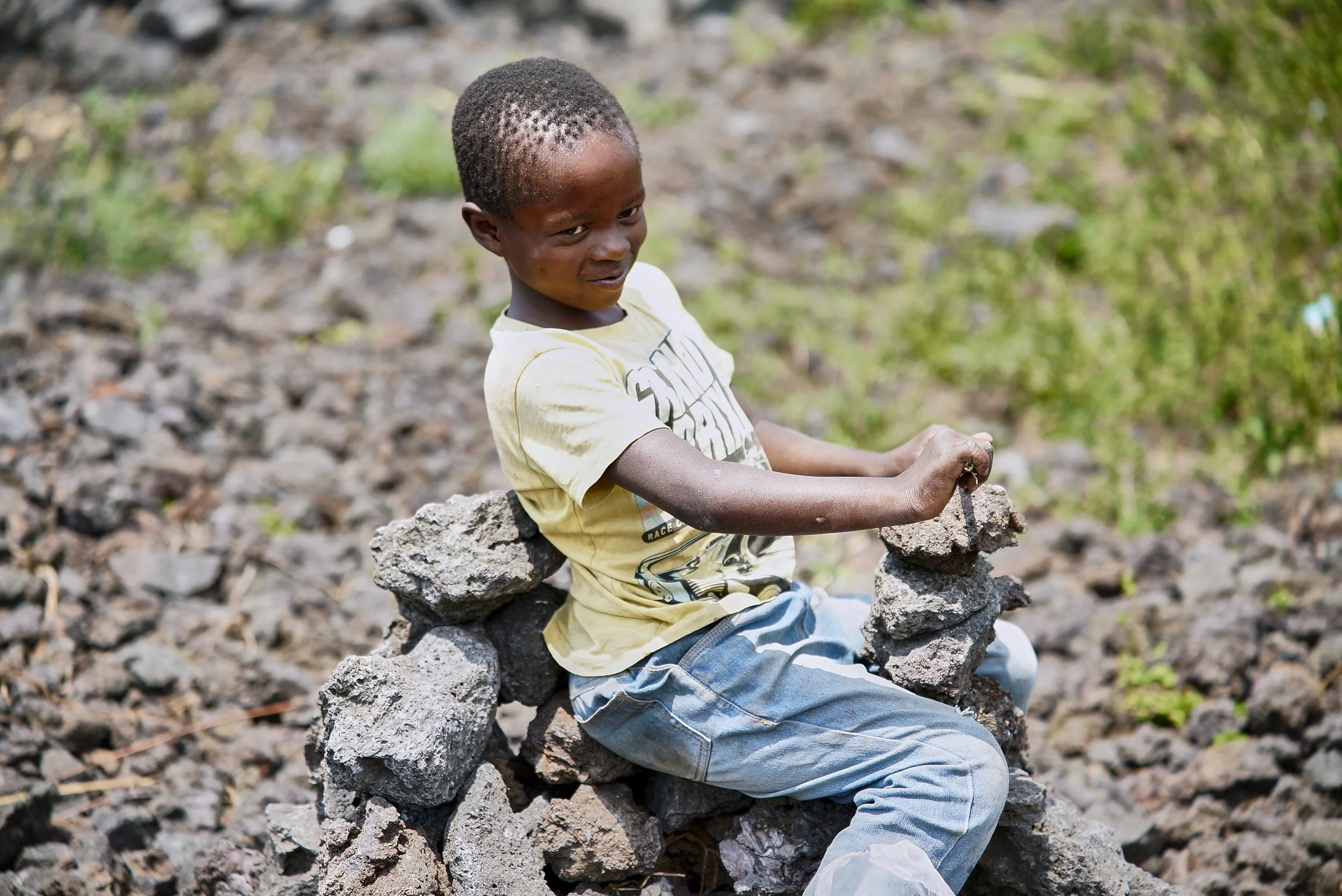
Image photographer: Isaac Jimmy
Ashuza has known a life shaped by war, by loss of livelihood, constant insecurity, and the quiet endurance of a land waiting for the flames and dust to finally settle.
At just seven years old, she is being raised in the smoke of conflict in the eastern region of the Democratic Republic of Congo, learning to understand life differently and far too early.
War has become her classroom. Survival, her daily lesson. Through hardship, she has learned by watching, by observing the work of humanitarian aid workers, who have become her most visible teachers. Her story echoes that of many children like her, whose visions of the future and access to education have been dimmed by war and the long shadow of its accompanying trauma.
The stain of war and its impact on young survivors
The language of war victims, especially children, often breaks down at the edges. Words are too small to hold the weight of what they carry: the fractures of loss, the fog of confusion, and the quiet grief that settles into the body long before it can be spoken. Much of their lived experience remains unnamed, unseen, lingering between silences.
For children who survive conflict, war does not end when the grenades cease; it rewires cognition, interrupts growth, and reshapes how the world is understood at its most formative stage.
While war is often framed as an unfortunate collision between nations, children are not signatories to these conflicts. Their right to education and protection has long been articulated through the Fourth Geneva Convention of 1949 and the 1951 Convention Relating to the Status of Refugees, yet classrooms have increasingly become casualties. Schools are no longer sanctuaries but targets.
From the demolished homes and learning spaces of the Democratic Republic of Congo across the war zones in Sudan and Somalia, protection has proven fragile and uneven.
Growing up amid rubble and displacement, children are deprived not only of material stability but also of the emotional scaffolding that gives rhythm, meaning, and continuity to social and cultural life.
This reality calls urgently for psychosocial support for children caught in conflict and for the protection of their linguistic and cultural rights. Equally urgent is creating space for them to reimagine life once the dust settles. In these moments, community-building and creative interventions carry real weight. Research from the Humanitarian Practice Network (HPN) reminds us that protection and education in conflict are not afterthoughts; they are lifelines. Education, even amid rubble, can shield children from family separation, abduction, sexual violence, and forced recruitment.
The effectiveness of art as a medium for psychosocial support
For children who have been victimised or carry the quiet imprint of violence, individual-centred educational programs help identify who is hurting and how support can be shaped.
Imagine a world where, despite their surroundings, children are given tools for self-expression; where art, language, and shared learning reopen pathways to connection and belonging. In this space, children are no longer passive casualties of history but active survivors, holders of experience, resilience, and the fragile beginnings of future worlds.
Creativity is multidimensional, especially in education. Yet while the creative industry has amassed billions, artistic expression is still widely seen as a pastime, a peripheral activity.
Research in the African Journal of Biomedical Research shows that art-based approaches can help children process trauma visually, reaching the personal, psychological, emotional, physiological, and functional layers of experience. In spaces shaped by war, art becomes more than expression; it becomes a tool for healing and survival.
The activist power of creativity in war-affected areas
So let's take a step forward to reimagine education through creativity. The Harvest Africa spoke with Isaac Jimmy, communication coordinator at Focus Congo. Rather than speaking of youth in general, Isaac considers their natural curiosity and creativity, seeing how these can become foundations for learning and growth.
Among the displaced youth in Eastern Congo, Ashuza stands out. She has been inspired by the work of on-the-ground humanitarian leaders, including Isaac, who have shown her that a dream can take shape even in the harshest conditions. As Isaac recalls, “She wanted to become a journalist. She loved holding the microphone and being in front of the camera. it just felt right for her.” But her passions stretch far beyond journalism. She delights in crafting with her hands, drawing, painting, and building small objects from found materials like bottle caps. Her natural curiosity, nurtured by the guidance and programs offered by Focus Congo, reveals how creativity can flourish even in places where resources are scarce.
Access to education is scarce in refugee camps, and even where it exists, the camps are rarely stable. Ashuza, like many children living there, struggles with inconsistent attendance and the difficulty of reaching learning spaces. Distance and instability make learning a daily challenge.
Isaac’s reflections bring another layer to the story. As a young adult working in humanitarianism, he acknowledges the psychological weight carried by those living in and responding to conflict. He shares, “My life is sometimes complicated and unbalanced, but there remains resilience and inner strength. Even during difficult periods, I stay calm and positive, reminding myself that every breath of life is precious: ‘I am alive, so all is well.’ This awareness helps me stay on course despite the trials.”
His words highlight a reality often overlooked: even as communities shift and adapt, the mental well-being of those who serve must be nurtured. War envelops everyone in its cycle, yet passion can sustain action. For Isaac, it is the desire to amplify the voice of his community and document reality to propose solutions: “I want to raise the voice of my community and document realities to then propose pathways for solutions so that human conditions are respected.”
Beyond art in activism is a passion toward real transformation
Isaac’s journey illustrates the evolution of creative expression. Once focused on literature, “I loved telling stories through books” he realised that writing alone reaches only a limited audience. Photography and multimedia tools allowed him to share stories more broadly and impactfully.
His approach to engaged, creative activism is rooted in experience: learning through reading, hands-on experimentation, observation, and discussion. Workshops with cameras, computers, and software give youth real skills, turning participation into action, dynamic, practical, and self-affirming. He emphasises that while some confidence comes from outside support, most must come from within. True success is measured by the lives we touch, with faith, community, and shared responsibility anchoring a legacy that unites and supports those we walk alongside.
As Isaac concludes: “It is about reminding young people that they have value, supporting them in their initiatives, and giving them the material and educational means to succeed.”
By investing in spaces that protect, teach, and allow children to express themselves, we do more than heal trauma; we cultivate the seeds of possibility, hope, and a new narrative for a generation too long defined by conflict.